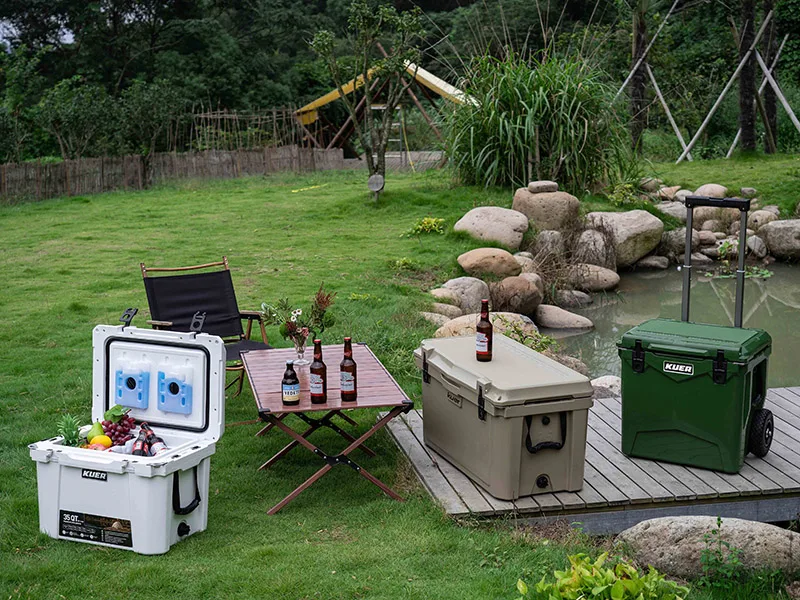

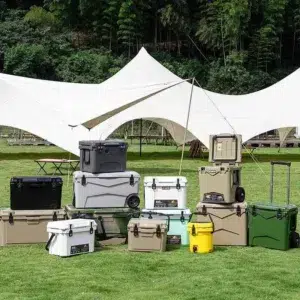
Rotomolded coolers keep ice frozen far longer than standard ice chests thanks to three synergistic design features: a seamless one-piece shell, thick high-density polyurethane foam insulation, and airtight freezer-grade seals. Working together, these elements drastically reduce heat transfer from conduction, convection, and air leakage.
Key Takeaways
- Seamless one-piece construction eliminates joint thermal bridges, cutting down convective heat leakage.
- Pressure-injected closed-cell polyurethane foam delivers nearly double the insulation per inch of standard EPS foam.
- Freezer-grade gaskets paired with heavy-duty latches create an airtight seal to stop cold air escape.
- High-quality rotomolded coolers hold ice for 5–7 days on average, with larger models reaching 10+ days.
- Pre-chilling the cooler and using block ice instead of cubes can extend retention by an extra 1–2 days.
How Rotomolded Construction Improves Cooler Ice Retention
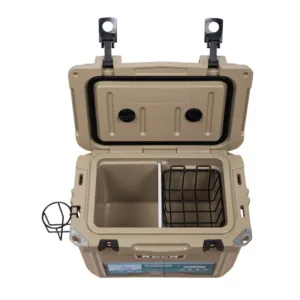
The rotational molding process creates the cooler shell as a single, uniform piece. Plastic powder is heated and spun on two axes inside the mold, coating the interior evenly and forming a completely seamless structure.
This is a fundamental difference from blow-molded or injection-molded coolers, which are assembled from multiple pieces. Seams and joints in standard coolers act as thermal weak points, allowing heat to seep in through convection and conduction. The seamless rotomolded design eliminates these weak points entirely.
| Thermal Efficiency Feature | Rotomolded Cooler (Seamless) | Standard Cooler |
|---|---|---|
| Shell Construction | Seamless, uniform thick-walled | Multi-piece, thin-walled, seamed |
| Insulation Type | Pressure-injected polyurethane | Expanded polystyrene or low-density foam |
| Gasket | Freezer-grade, airtight | Simple lid contact or poor seal |
| Typical Ice Retention | 5–10+ days | Hours to 1–2 days |
| Primary Heat Loss | Slow conduction | Rapid convection, conduction, and air leakage |
| Lid Seal | Airtight compression gasket | Loose or friction-fit |
The uniform wall thickness also delivers consistent thermal performance with no thin spots that would compromise insulation. The rigid one-piece structure also improves durability: KUER rotomolded coolers survive 15-meter drops and resist over 8,000 hours of UV exposure, with no weak seams to crack under stress.
Why Does Polyurethane Foam Keep Coolers Colder?
The insulation layer is the core barrier against outside heat, and rotomolded construction allows for far thicker, higher-quality foam than standard coolers.
Closed-Cell Polyurethane vs. Styrofoam
High-end rotomolded coolers use pressure-injected closed-cell polyurethane (PU) foam, which fills the entire wall cavity completely with no air gaps. Each tiny foam cell traps insulating gas inside, creating a much higher thermal resistance (R-value) than standard foam materials.
| Material | R-value per Inch |
|---|---|
| Closed-cell polyurethane | R-7 to R-8 |
| Extruded polystyrene (XPS / Styrofoam) | R-5.0 |
| Expanded polystyrene (EPS) | R-3.6 |
Per inch, polyurethane delivers nearly double the insulation of EPS foam. This advantage is critical because cooler wall space is limited — higher R-value per inch means more insulating power in the same footprint.
The closed-cell structure also delivers long-term performance. PU foam resists moisture absorption, so it stays effective even when wet. Open-cell foams like EPS soak up water over time, which destroys their insulating ability. In rotomolded coolers, 2–3 inches of high-density PU foam lines the walls, floor, and lid, creating a continuous thermal barrier on every surface. The foam also resists compression, so it maintains its shape and insulating power for years of use.
How Tight Seals Extend Ice Life
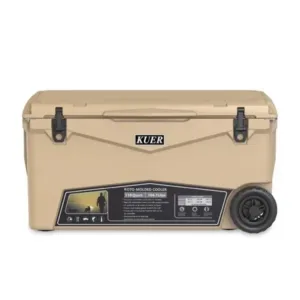
Even the best insulation is wasted if cold air escapes through gaps around the lid. Even a tiny opening allows warm air in and cold air out, accelerating ice melt.
Freezer-Grade Gaskets
Rotomolded coolers use commercial-grade rubber or silicone gaskets around the lid perimeter. When the lid closes, the gasket compresses to form an airtight barrier that blocks air exchange between the cold interior and warm exterior. A simple test verifies seal integrity: close the lid on a dollar bill — if the bill slides out easily, the seal is insufficient.
Heavy-Duty Latches
Latches play a critical role in maintaining seal pressure, especially during transport and rough use. They apply steady, even pressure to the gasket to keep the seal tight even when the cooler is bumped, jostled, or loaded.
Cheaper coolers often use flimsy latches and thin lids that warp over time, causing the seal to fail. KUER rotomolded coolers feature heavy-duty latches and a leak-proof drain plug — the drain prevents water buildup inside that could degrade seal performance over time.
Pro Tips to Make Ice Last Even Longer
- Pre-chill the cooler box and its contents before packing to lower the starting internal temperature.
- Use block ice instead of cubed ice — it melts slower and lasts longer.
- Pack the cooler as full as possible to minimize empty air space inside.
- Limit lid openings to reduce warm air infiltration.
FAQ
How long do rotomolded coolers keep ice?
A high-quality rotomolded cooler like KUER holds ice for 5–7 days in typical outdoor weather. Larger 70-quart+ models can retain ice for 7–10 days — roughly 2–3 times longer than a standard consumer ice chest.
What makes a rotomolded cooler different from a standard ice chest?
Rotomolded coolers have three key advantages: a seamless one-piece shell, thick closed-cell polyurethane foam insulation, and an airtight freezer-grade lid seal. Standard ice chests have seamed construction, thin low-grade foam, and loose-fitting lids, leading to much faster ice melt.
Does pre-chilling a cooler really help?
Yes. Pre-chilling the cooler and its contents lowers the initial internal temperature, which significantly extends ice life. Packing tightly and using block ice instead of cubes amplifies this effect even further.
Are hard coolers durable enough for rough outdoor use?
KUER hard coolers survive drops from up to 15 meters and resist over 8,000 hours of UV exposure. Heavy-duty latches and a leak-proof drain maintain a tight seal even through rough handling and bumpy transport, making them ideal for camping, fishing, and expeditions.
Can users customize a rotomolded cooler?
Yes. KUER offers customization for colors, logos, and accessories like baskets and dividers. The brand produces 1,500 coolers per day, delivering consistent quality at competitive pricing.

 Request a quote
