
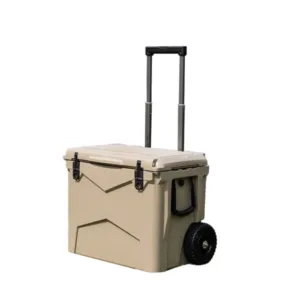
Wheeled coolers are heavy by design, driven by four intentional engineering choices: thick insulating foam, rugged impact-resistant construction, large storage capacity, and heavy-duty wheel-and-handle hardware. Every extra pound serves a clear performance purpose — longer ice retention, crack resistance, higher load capacity, or durability on rough terrain.
Key Takeaways
- Thick, dense insulation is the single biggest source of weight, and it directly extends how long ice stays frozen.
- Rotomolded plastic shells and metal hardware create a tough, long-lasting build that adds noticeable mass.
- Larger storage volumes and extra utility features add weight by requiring more material to construct.
- The wheel, axle, and frame system must support heavy full loads, so it is built with thick, heavy-duty parts.
Thick Insulation: The Biggest Weight Driver in Wheeled Coolers
Insulation accounts for more weight than any other single component. A cooler that holds ice for multiple days must slow heat transfer to a near standstill, which requires layers of foam and plastic that add measurable mass.
Wall Thickness & Ice Retention
High-performance coolers use a three-layer sandwich construction: an outer plastic shell, a foam core, and an inner liner. Each layer blocks heat in a different way: the hard shell stops airflow and impacts, the foam slows conduction, and the liner seals cold air inside.
Thicker walls directly equal longer ice life, but they also require more material. A multi-day wheeled cooler has far thicker walls than a basic picnic model, making it noticeably heavy even when completely empty.
Dense Foam Core
Foam density matters just as much as thickness. Budget coolers use lightweight, air-filled foam that insulates well per ounce but compresses over time and loses performance. Premium wheeled coolers use high-density foam that resists compression and holds its insulating power season after season. Denser foam packs more material into the same volume, adding weight but delivering far more reliable long-term performance.
This is a deliberate performance tradeoff, not a design flaw. Buyers prioritizing maximum ice life accept the extra weight, while casual users can opt for lighter models with shorter ice retention.
Rugged Construction Adds Durability (and Pounds) to Wheeled Coolers
Wheeled coolers travel over gravel, sand, truck beds and rough campsites. To survive this abuse, manufacturers build them with heavy-duty materials that add scale weight but prevent cracks, warping and broken hardware.
Rotomolded One-Piece Shell
Most premium wheeled coolers use rotomolded construction: powdered plastic is melted and rotated inside a mold, cooling into a single seamless thick wall. No seams means no weak points, and the resulting shell is extremely resistant to dents, cracks and UV damage. The thick, dense plastic also weighs significantly more than thin injection-molded alternatives.
Heavy-Duty Hardware
Budget coolers use thin plastic hinges, latches and pins. Heavy-duty wheeled models replace these with steel pins, metal hinges and reinforced latches with strong springs. These parts are nearly indestructible in normal use, but they add noticeable mass compared to plastic alternatives.
Reinforced Lids & Seals
Small upgrades add up quickly. Reinforced lids (sometimes with a metal core) resist warping and support standing weight. Heavy-duty rubber gaskets create an airtight seal to lock in cold. Each fix solves a real failure point — warped lids leak cold air, weak latches pop open on bumpy roads — but all together they push total weight higher.
Larger Capacity and Extra Features of Wheeled Coolers
Wheels fundamentally change what a cooler can be. Since a person can pull a large loaded cooler across pavement with one hand, cooler manufacturers build far larger capacities than would be practical to carry by hand.
A typical empty mid-size wheeled cooler weighs roughly 37.5 pounds, and that number climbs quickly as capacity grows. More interior volume means longer walls, a bigger base and a heavier lid, all adding material and mass.
Many wheeled models also include extra utility features that add weight:
- Built-in cup holders, fish rulers and cutting board lids
- Towable hitch mounts for pulling behind ATVs or vehicles
- Tie-down slots and external storage pockets
- Integrated dolly frames for hauling additional gear
Each feature adds practical value, but also requires extra material that increases total weight.
Heavy-Duty Wheel and Handle Systems on Wheeled Coolers
The wheel and handle assembly has to support a fully loaded cooler — which can weigh well over 100 pounds with ice, food and drinks inside. Weak wheels or thin axles would crack under that load, so manufacturers overbuild these components.
Wheels, Axles & Base Frames
Thick, wide wheels and solid axles roll over gravel, sand and uneven ground without cracking. The base frame spreads weight evenly across the cooler bottom to prevent flexing. These parts are made from dense reinforced plastic and metal, which adds significant weight but ensures long-term durability.
Telescoping Handles
Sturdy telescoping handles and internal support frames improve ergonomics for pulling heavy loads. A rigid handle reduces strain on the user, but the frame and locking mechanism add extra mass to the unit.
Are Heavy Wheeled Coolers Worth the Extra Weight?
Whether the weight is worth it depends entirely on how you use the cooler.
When a Heavy Cooler Is the Right Choice
A heavy, rugged wheeled cooler earns its keep on:
- Multi-day camping trips where long ice retention is critical
- Off-road or rough-terrain use where impact resistance matters
- Large group events where maximum capacity is needed
- Regular use where long-term durability lowers total cost over time
When a Lighter Cooler Works Better
Lighter wheeled coolers are a better fit for:
- Short day trips and picnics
- Situations where you will frequently lift the cooler in and out of vehicles
- Soft ground like deep sand, where lighter weight is easier to pull
- Tight storage spaces where compact size is a priority
There is no universal “best” choice. The right cooler balances weight, ice life and durability to match your actual use case.
FAQ
Why does my wheeled cooler feel heavier than the listed weight?
Listed weights always refer to the empty cooler. Ice, food and drinks add substantial mass — a fully loaded unit can feel twice as heavy as the empty spec. Always plan lifting around the packed weight, not the empty number.
Do bigger wheels make a cooler easier to move?
Larger wheels roll much more easily over gravel, sand and uneven ground, but they also add more weight to the unit. They improve rolling performance but make lifting into vehicles harder.
Can one person safely lift a fully loaded wheeled cooler?
A person can lift a lightly loaded cooler short distances with proper technique. For truck beds, stairs and heavy full loads, a two-person lift is always safer to avoid back strain.
Does a heavier cooler always last longer?
Heavier build quality usually correlates with thicker materials and more durable hardware, which do extend lifespan. Longevity also depends on material quality and care — a well-built lightweight cooler can last many seasons with proper use.
What features add the most weight to a rolling cooler?
Thick dense insulation, rotomolded construction, metal hardware and larger capacity drive most of the empty weight. Towable mounts, dolly frames and extra accessories add additional mass.


 Request a quote
