

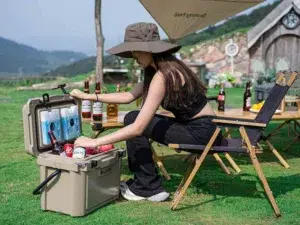
To keep perishable food safe for camping, picnics and tailgating, a cooler must hold an internal temperature of 40°F (4°C) or below, with an ideal target range of 34–38°F. This threshold stops rapid bacterial growth, and a few simple packing and monitoring habits will keep food safely cold through full days outdoors.
Key Takeaways
- Keep cooler internal temperature at 40°F or below to slow bacterial growth and keep food safe.
- Check temperature with a food thermometer at setup and midday to confirm safe holding.
- Discard perishable food that stays above 40°F for more than 2 hours total (1 hour in 90°F+ heat).
Safe Cooler Temperature Standards
The 40°F Food Safety Threshold
Cold food holding works best between 34–38°F, which leaves a small safety buffer for warm afternoons and frequent lid openings. The maximum safe limit is 40°F — this matches standard commercial refrigeration rules, including walk-in cooler requirements of 41°F (5°C) or below. Portable coolers follow the exact same food safety standard.
The Temperature Danger Zone
Bacteria multiply fastest in the 40°F to 140°F danger zone. A cooler that rises above 40°F becomes a breeding ground for harmful bacteria within hours. For frozen items, maintain temperatures of 0°F (-18°C) or below to prevent thawing and spoilage.
Why You Can’t Guess Temperature
Coolers do not hold refrigerator temperatures passively. Sun exposure, warm ambient air and frequent lid openings all push internal temperatures upward. Even premium multi-day ice retention coolers need periodic checks to confirm food stays in the safe range. Guessing leads to avoidable food safety risk — a quick thermometer reading removes all uncertainty.
How to Accurately Measure Cooler Temperature
Best Thermometer Options
A basic appliance or food thermometer gives the most reliable readings. Choose an easy-to-read dial or digital model, and place it near the center of the cooler, not pressed against the wall — the middle reflects the actual temperature surrounding your food. For large coolers, use two thermometers (one upper, one lower) to confirm consistent cooling throughout the box, since cold air sinks.
For the most accurate reading, check the thermometer before opening the lid. Lifting the lid lets warm air rush in and skews readings for several minutes after closing.
How Often to Check
Take readings at three key points during your trip:
- After initial setup, once ice and food are fully loaded
- Midday, after several hours of outdoor exposure
- Any time conditions change — moving from shade to direct sun, or leaving the cooler in a hot car trunk
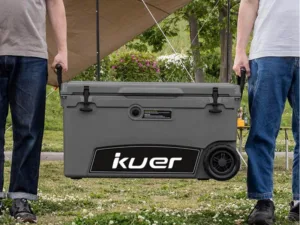
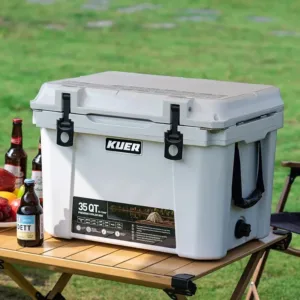
For multi-day trips, a high-performance cooler makes this much easier. The KUER Cooler Box uses 2+ inches of PU foam insulation and a high-quality gasket seal to deliver 5–7 days of ice retention under normal outdoor conditions. Its rotomolded LLDPE construction offers 27J impact strength and 8000-hour UV resistance, with sizes ranging from 20QT to 75QT (including wheeled options for larger loads). Included baskets and compatible gel packs help keep food organized and consistently cold.
What to Do If Cooler Temperatures Rise Too High
The 2-Hour Safety Rule
Perishable food may sit above 40°F for a maximum of 2 hours total. When outdoor air temperature reaches 90°F or higher, cut this window to 1 hour. Move food back onto ice immediately if you see readings climb above the safe limit.
When to Discard Food
Throw away any perishable food that has stayed above 40°F for longer than the safe window. Discard items that feel warm to the touch, have off odors, or show slimy texture. Never taste questionable food to test it — when in doubt, throw it out.
If you catch the temperature rise early, add fresh ice, drain existing meltwater, and move the cooler box to a cooler, shaded location to bring temperatures back down to the safe range.
FAQ
What temperature keeps food safe in a cooler during trips?
Keep the internal temperature at 40°F (4°C) or below, with an ideal range of 34–38°F. Temperatures above 40°F enter the bacterial danger zone and put food at risk of spoiling. A thermometer is the only reliable way to confirm safe holding.
How does this compare to walk-in cooler temperature standards?
It follows the exact same rule. Commercial walk-in coolers are required to hold food at 41°F (5°C) or below, with an ideal set point near 38°F. Portable coolers use the same food safety threshold.
How long can food safely stay above 40°F?
Perishable food gets a maximum of 2 hours total in the danger zone. That limit drops to 1 hour when ambient air temperature is 90°F or higher. Move food back onto ice immediately, and discard any items that exceed the safe window.
Do frozen foods need a different temperature?
Yes. Frozen foods must stay at 0°F (-18°C) or below. Keep them separate from meltwater, and use dedicated gel packs for frozen items if you are mixing chilled and frozen goods in one cooler.
What packing habits best support food safety?
Pre-chill the cooler before loading, use a 2:1 ice-to-food ratio, pack contents tightly with no empty air gaps, layer ice on top, and keep lid openings to a minimum. These habits extend cold holding and keep food safely in the temperature danger zone.

 Request a quote
