
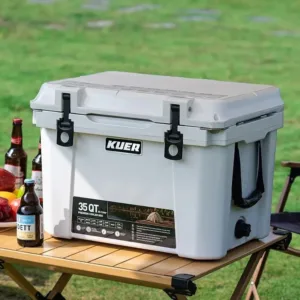
A great camping cooler box keeps drinks cold and food fresh for days, even on hot afternoons. The right choice depends on matching the cooler type to your trip length, group size, and activity style. The most important factors are insulation quality, ice retention, portability, and durability. With the right knowledge, you can avoid spoiled meals and enjoy reliable cooling on every outing.
Key Takeaways
- Match cooler type to your trip: hard-sided for multi-day stays, soft-sided for day hikes, electric for powered car camping.
- Insulation thickness is the biggest driver of ice retention; thick closed-cell foam keeps ice frozen for days.
- Size your cooler to your group and trip length, and follow a 2:1 ice-to-food ratio by volume.
- Wheels and telescoping handles make loaded coolers far easier to transport, especially over rough terrain.
- Use a two-cooler strategy (one for drinks, one for food) to cut down on lid openings and extend food freshness.
Common Camping Cooler Box Types
There are five main cooler categories, each built for different use cases.
| Cooler Type | Typical Ice Retention | Core Pros | Core Cons | Best For |
|---|---|---|---|---|
| Hard-sided (rotomolded) | 5–7+ days | Seamless one-piece shell, maximum impact resistance, best insulation | Heavier, higher price point | Long camping trips, rough terrain, off-roading |
| Hard-sided (injection-molded) | 3–5 days | Up to 30% lighter than rotomolded, good insulation | Corners can crack under hard impact | Weekend trips, car camping, general use |
| Hard-sided (blow-molded) | 2–3 days | Lowest cost hard-shell option | Thinner insulation, shorter lifespan | Budget-focused short trips |
| Soft-sided | 24–48 hours | Ultra lightweight, easy to carry and store, backpack-compatible | Thin insulation, limited ice life | Day hikes, picnics, backpacking |
| Electric | Unlimited with power | Precise temperature control, can cool or warm | Requires 12V power, heavier, not for backcountry | Car camping, road trips, RV stays |
Key Features to Evaluate for a Cooler Box
Size & Capacity
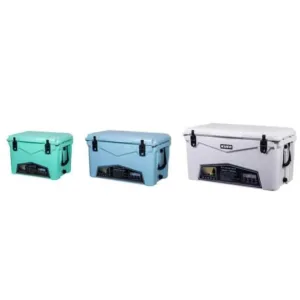
Choose capacity based on group size and trip length. A 2:1 ice-to-food volume ratio is the standard guideline for best cooling.
| Group & Trip Length | Recommended Cooler Size |
|---|---|
| Solo / pair, 1–2 day trip | 8–20 quarts |
| Solo / pair, 2–3 day trip | 24–40 quarts |
| Family of 4, weekend trip | 30–45 quarts |
| Family of 4, 3+ day trip | 65–75 quarts |
| Large group / extended trip | 50–100+ quarts |
For reference, 20–30 quart coolers work well for day outings, while 50+ quart models are built for longer adventures.
Insulation & Ice Retention
Insulation quality is the single biggest factor in cooling performance. Thick closed-cell foam slows heat transfer far better than thin, low-density foam. Independent testing shows how insulation design impacts real-world ice retention:
| Cooler Model | Construction | Insulation Thickness | Tested Ice Retention |
|---|---|---|---|
| Xspec | Rotomolded | 3 inches | 9+ days |
| RTIC Ultra-Light 52 | Injection-molded closed-cell foam | 3 inches | 7 days |
| YETI Tundra | Rotomolded | 2 inches | 9 days |
| Coleman Classic Series | Blow-molded | N/A | 6 days |
Rotomolded seamless shells also prevent air leakage that would speed up melting. For multi-day summer camping, prioritize a rotomolded or injection-molded cooler with thick closed-cell foam.
Portability & Durability
- Portability: A fully loaded hard cooler can weigh over 50 pounds. Wheels and telescoping handles make transport much easier. Small smooth wheels work on pavement; large rubber tires handle sand, grass, and gravel better.
- Durability: Rotomolded construction resists impact and vibration best for rough terrain. Injection-molded coolers are lighter but can crack at corners. Blow-molded models are lowest cost but least durable.
- Usability: Drain plugs and removable liners make post-trip cleanup simpler. Internal cooler baskets help organize contents without digging through ice.
Match Your Cooler to Your Trip
By Activity & Terrain
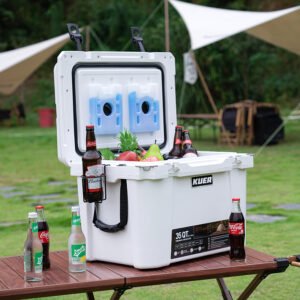
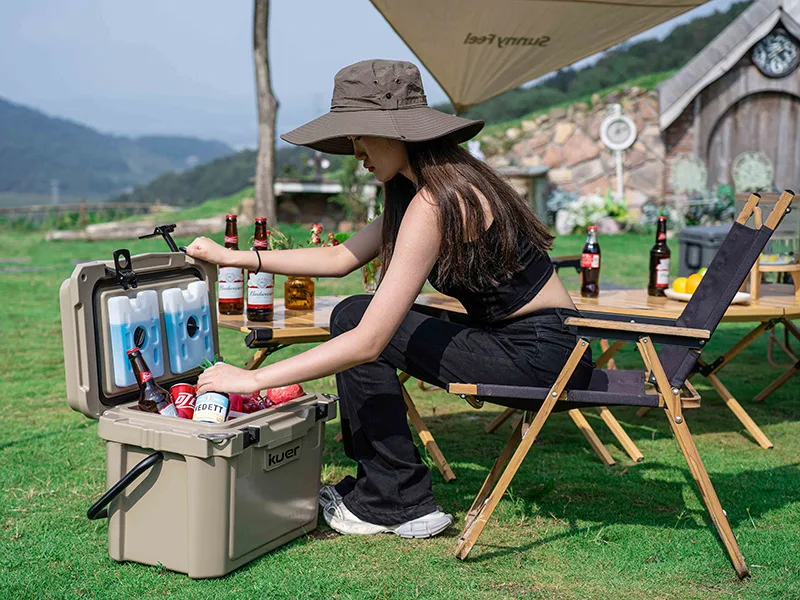
- Car camping / group trips: A hard-sided wheeled cooler delivers maximum ice retention and capacity. Wheels are essential for moving heavy loads across campsites.
- Backpacking / hiking: A lightweight soft-sided cooler with ergonomic straps keeps essentials cold without weighing you down. Soft models also fit easily in tight tent spaces.
- Off-road / rugged terrain: Choose a rotomolded cooler with stainless steel hardware, heavy-duty latches, and non-slip feet for maximum durability.
Pro Packing Tip
Use two coolers: one for drinks (opened frequently) and one for perishable food (opened less often). This strategy keeps the food cooler closed longer, extends ice life, and reduces the risk of food spoilage.
FAQ
How long does ice stay frozen in a high-quality hard cooler?
Independent tests show premium rotomolded coolers keep ice frozen for 5–7 days under normal outdoor conditions. Injection-molded models typically hold ice for 3–5 days. Foam quality and thickness are the biggest performance factors.
Can a soft-sided cooler handle a weekend camping trip?
Most soft-sided coolers only keep ice for 24–48 hours. For weekend trips longer than two days, choose a hard-sided cooler with better insulation and longer ice retention.
What size cooler fits a family of four?
A 30–45 quart cooler works for a family of four on a standard weekend trip. For 3+ day outings, size up to 65–75 quarts. Always remember the 2:1 ice-to-food ratio when packing.
Do wheels help when moving a loaded cooler?
Yes. A fully loaded hard cooler can weigh over 50 pounds. Wheels make transport much easier, especially across grass, gravel, or sand. Look for large, durable wheels for uneven terrain.
Is an electric cooler a good choice for camping?
Electric coolers work great for car camping and road trips where you have access to 12V vehicle power or a portable battery. For backcountry trips without power, stick to a passive insulated cooler.

 Request a quote
