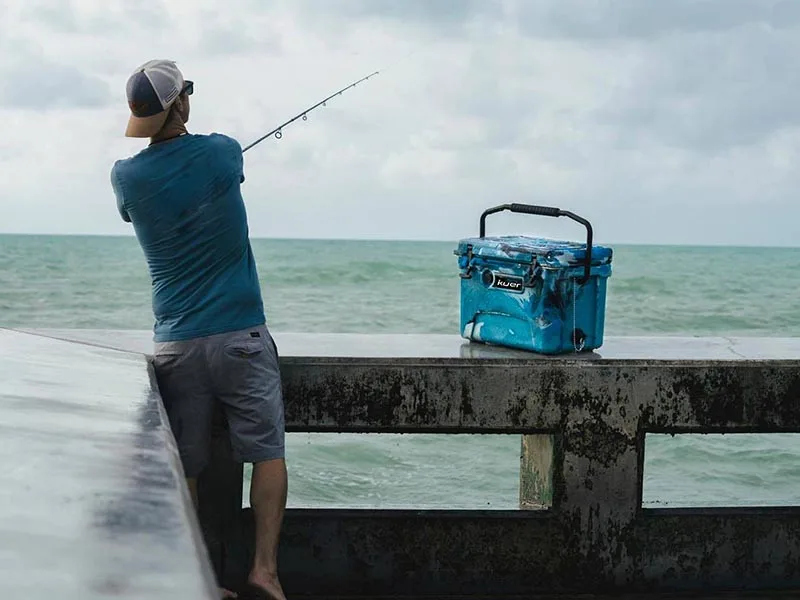

Rotomolded coolers are manufactured through a low-pressure rotational molding process that forms a single, seamless plastic shell with uniformly thick walls. A hollow mold filled with polyethylene powder spins on two axes inside a heated oven, melting the plastic so it coats the inner mold surface evenly by gravity. The result is a one-piece cooler body with no seams, weak points, or thin spots — the exact reason rotomolded designs dominate heavy-duty, outdoor, and marine cooler categories.
Key Takeaways
- Rotational molding uses a heated, dual-axis spinning mold to create a seamless, one-piece polyethylene cooler shell.
- Food-grade LLDPE/HDPE forms the outer shell; closed-cell polyurethane foam delivers 5–7 days of ice retention.
- The seamless, even-wall construction resists impacts, leaks, and UV damage far better than multi-piece injection-molded coolers.
- Performance additives like impact modifiers and UV stabilizers extend lifespan and real-world durability.
- Every unit undergoes full quality checks for wall thickness, lid seal, hinge strength, and drainage before shipping.
Core Materials Used in Rotomolded Coolers

Three core material systems define rotomolded cooler performance: the outer plastic shell, the insulation layer, and performance additives mixed into the resin.
Outer Shell Resin
Food-grade polyethylene is the standard shell material, used in powder form for optimal rotomolding flow. It is non-toxic, corrosion-resistant, and naturally water-resistant — all critical for food and beverage storage.
Two grades dominate cooler production:
- LLDPE: Most common for rotomolded coolers. Flows smoothly inside the heated mold to create consistently even wall thickness.
- HDPE: Higher rigidity option for heavy-duty designs.
Particle size distribution is tightly controlled to ensure even melting: 250–400 μm median size, with less than 5% coarse fraction and less than 15% fine fraction. A balanced blend prevents lumps and delivers uniform wall thickness across the entire part.
Insulation Layer
Behind the plastic shell, insulation determines ice retention performance:
- Closed-cell polyurethane (PU) foam: Standard for most rotomolded coolers. Dense, pressure-injected into the shell cavity, where it bonds to the inner wall and adds structural rigidity. Thick PU foam keeps ice frozen for 5–7 days.
- PE foam: Lighter, lower-cost option for budget coolers, with weaker insulating performance.
- Vacuum + PU foam: Premium dual-insulation design for top-tier models.
Performance Additives
Raw polyethylene is brittle and degrades in sunlight. Manufacturers mix small doses of additives into the powder at the formulation stage:
- Impact modifiers: Make the plastic bend instead of cracking under sudden impact.
- UV stabilizers: Prevent polymer chain breakdown from sun exposure, reducing fading and brittleness. High-end formulations deliver over 800 hours of UV resistance.
These additives make up only a few percent of the final weight, but they drastically improve real-world durability without changing the core molding process.
The Rotomolding Process Step-by-Step
Unlike injection molding, which forces molten plastic into a mold under high pressure, rotomolding uses gravity and dual-axis rotation to coat the inner mold surface evenly. The process has three core stages.
1. Mold Prep & Loading
First, operators prepare the mold for a clean release:
- Clean the mold cavity fully to remove residue from previous runs.
- Apply a release agent to inner surfaces so the finished part separates easily.
- Close and clamp the mold tightly to prevent leaks during rotation.
Next, operators weigh out a precise charge of plastic powder and pour it into the hollow cavity. Powder weight directly determines final wall thickness — heavier charges build thicker walls.
2. Heating & Dual-Axis Rotation
The sealed mold enters an oven, and the core of the process begins. The mold rotates slowly on two perpendicular axes: one spins it end-over-end, the other turns it side-to-side.
This dual motion ensures molten polyethylene flows evenly over every square inch of the mold interior. As the plastic heats and becomes tacky, it coats the walls in a continuous, even layer. No pressure, ram, or screw is involved.
The result is a single, seamless shape with far more uniform wall thickness than injection molding — typically within ±10% consistency. There are no weld lines, seams, or built-in stress points.
3. Cooling & Demolding
After heating, the mold moves to a cooling station. Fans and water spray remove heat while the mold continues to rotate evenly. Uniform cooling prevents warping or uneven shrinkage that would pull the shell away from the mold surface.
Once the plastic fully stiffens, the mold opens and the finished shell is removed. Workers trim any flash at the parting line and inspect the surface for defects.
How Are Rotomolded Coolers Assembled and Tested?
The bare shell moves to assembly and testing before shipping.
Final Assembly
- Insulation fill: Closed-cell PU foam is pressure-injected into the hollow shell cavity, where it expands and bonds to the inner wall.
- Hardware fit: Workers install lid gaskets, ergonomic handles, optional wheels, and large leak-proof drain plugs.
- Function checks: Latch tension, handle play, and drain operation are all tested.
Quality Control Testing
Every batch passes through a full inspection checklist before shipping:
- Wall thickness uniformity and insulation density
- Lid seal integrity (verified with a paper-trap test)
- Hinge strength and cycle testing
- Drainage quality and cleaning access
- UV resistance and food-contact certification
- Resin batch traceability
For context, KUER is a cooler manufacturer that produces 1,500 rotomolded coolers per day in its 65,000 m² facility, with every unit going through the same full inspection routine.
Why Rotomolding Is Used for Coolers
Rotomolding dominates heavy-duty cooler manufacturing for one core reason: it creates a one-piece, uniformly thick shell that outperforms multi-piece designs on nearly every durability metric.
Core Advantages of Rotomolded Construction
- Seamless body: No welded or joined seams means no inherent weak points. There is nowhere for water to leak through, and no seam to split under impact or repeated rough handling.
- Uniform wall thickness: Every side, base, and corner has the same wall thickness, so insulation performance is consistent across the entire cooler and impact protection is even in all directions. Extra material at corners naturally absorbs shock.
- Long-term durability: Impact-modified shells survive drops of up to 15 meters without cracking. UV-stabilized formulations hold up through years of sun exposure without becoming brittle or fading.
Rotomolded vs. Injection-Molded Coolers
| Aspect | Injection-Molded Coolers | Rotomolded Coolers |
|---|---|---|
| Construction | Multi-piece assembled | One-piece seamless |
| Seams | Present; act as structural weak points | None |
| Impact resistance | Low; seams crack under stress | High; absorbs impacts without splitting |
| Wall consistency | Less uniform | Uniform within ±10% |
| Best use case | Light-duty, occasional use, low cost | Heavy-duty, outdoor, marine, long trips |
| Lifespan | Shorter | Longer; better long-term value |
In short: choose rotomolded for heavy use, outdoor conditions, and long service life; choose injection molded for light, infrequent use at a lower upfront cost.
FAQ
How long do rotomolded coolers keep ice?
Thick closed-cell PU foam keeps ice for 5–7 days in most conditions. Exact retention depends on foam density, thickness, and ambient temperature.
How much impact can a rotomolded cooler take?
High-quality impact-modified rotomolded shells survive drops of up to 15 meters without cracking. The seamless structure distributes shock evenly instead of concentrating it at seams.
What sizes do rotomolded coolers come in?
KUER’s rotomolded lineup ranges from 20QT personal coolers to 110QT large models, with wheeled and handled configurations available. Most manufacturers offer sizes for day trips through long expeditions.
Can you customize rotomolded coolers?
Yes. Most manufacturers offer custom colors, logo printing, and accessories like baskets, dividers, and drain plugs. Volume orders can be customized for brand colors and configurations.
How do you maintain a rotomolded cooler?
Clean after each use with mild soap, rinse thoroughly, and air dry with the lid slightly ajar to prevent odors. Use the built-in drain for easy emptying and cleaning. Avoid abrasive cleaners that can scratch the interior.


 Request a quote
