
Yes, you can bring a cooler through TSA airport security and on board a plane, in both carry-on and checked bags. The Transportation Security Administration does not ban coolers themselves — screening focuses entirely on the contents inside, not the container.
Rules differ based on whether you pack it as a carry-on or checked item, and what you store inside. Frozen items must stay solid for carry-on approval, while checked bags follow looser guidelines. Ice packs, gel packs, and dry ice have specific requirements, and airline size and weight limits apply.
Key Takeaways
- TSA allows coolers in both carry-on and checked bags; screening judges contents, not the container.
- For carry-on, ice packs and frozen items must be completely solid at screening; partly melted items fall under the 3-1-1 liquids rule.
- Checked bags have looser content rules and accommodate hard-sided coolers, subject to airline weight limits.
- Dry ice is permitted in both bag types, limited to 5.5 lbs per passenger, and must be properly vented.
- Soft-sided coolers work best for carry-on; hard-sided coolers are ideal for checked luggage.
- Always confirm your airline’s size and weight policies before flying.
Carry-On vs. Checked Cooler Rules
The biggest difference in rules comes down to whether you travel with the cooler in the cabin or check it as luggage.
| Category | Carry-On Bags | Checked Bags |
|---|---|---|
| TSA status | Allowed | Allowed |
| Frozen items rule | Must be completely solid at screening | No frozen-solid requirement |
| Ice / gel packs | Must be frozen solid; partly melted = 3-1-1 liquids rule | Allowed in any state |
| Size limits | Must meet airline carry-on dimensions | Must meet airline checked baggage limits |
| 3-1-1 liquids rule | Applies to non-frozen gels/liquids | Does not apply |
| Final authority | TSA checkpoint officer | TSA + airline baggage policies |
The 3-1-1 Liquids Rule (Carry-Only)
Partly melted gel packs, slushy frozen items, or liquid containers fall under the standard TSA 3-1-1 rule:
- Each container must be 3.4 oz (100mL) or less.
- All containers must fit in one quart-sized clear plastic bag per passenger.
Exception: Medically necessary gel packs are allowed in reasonable quantities regardless of state. Notify the TSA officer at screening for separate inspection.
What You Can Pack in a Cooler for Air Travel
Allowed Items
- Solid food: Sandwiches, fruit, cooked meats, and other solid snacks face no restrictions.
- Fully frozen liquids, ice packs, and gel packs: Permitted in carry-on when solid; permitted in any state in checked bags.
- Dry ice: 5.5 lb (2.5 kg) limit per passenger, in both carry-on and checked bags. Packages must be vented to allow gas escape. Check with your airline first, as carriers may add additional restrictions.
- Empty cooler: No restrictions beyond airline size limits.
Prohibited & Restricted Items
- Partly melted ice/gel packs over 3.4 oz in carry-on
- Non-frozen liquids over 3.4 oz in carry-on
- Loose ice in carry-on bags
- Alcohol over 140 proof
Dry Ice Guidelines
Dry ice is allowed in both carry-on and checked luggage with a 5.5 pound per passenger FAA limit. Packages must be vented so carbon dioxide can escape. Always check with your airline before traveling, as some carriers impose extra restrictions. Place dry ice at the bottom of the cooler for best results.
Hard-Sided vs. Soft-Sided Coolers
| Type | Best For | Pros | Cons |
|---|---|---|---|
| Soft-sided | Carry-on, personal item | Flexible, fits under seats, lightweight | Limited capacity, less protection |
| Hard-sided | Checked luggage | Durable, wheels for transport, large capacity | Usually too big for carry-on, heavier |
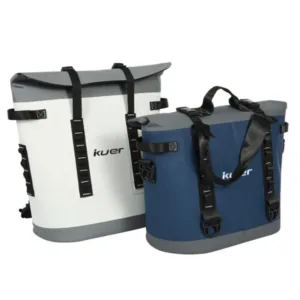
Soft-sided coolers most often work as a personal item or carry-on if they fit under the seat or in the overhead bin. Small insulated lunch bags often qualify as personal items. Hard-sided coolers typically exceed carry-on size limits, so they are almost always checked as luggage.
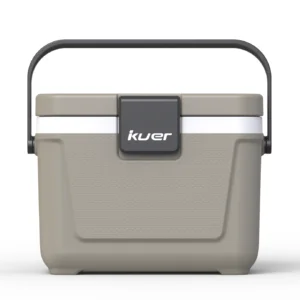
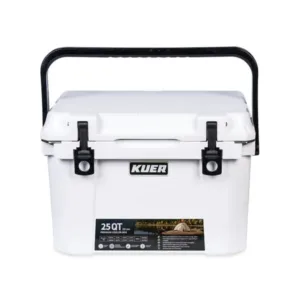
For reference, the KUER 110QT rotomolded hard cooler with wheels fits standard checked bag limits for rugged travel, while the KUER 30-can insulated soft lunch cooler works well as a carry-on personal item.
Airline Size & Weight Limits
Airlines set their own size, weight, and dry ice policies beyond TSA rules. Always confirm with your carrier before flying.
| Airline | Checked Size Limit | Checked Weight Limit | Key Notes |
|---|---|---|---|
| United Airlines | 62 linear inches max | 50 or 70 lbs (based on ticket/status) | Hard-sided plastic accepted; Styrofoam alone not accepted |
| American Airlines | Under 62 linear inches | Under 50 lbs | Must be taped, locked, or secured; oversize/overweight fees apply |
| General standard | Standard checked-bag dimensions | ~50 lbs | Counts as a standard checked bag |
For carry-on, most airlines use a 22 x 14 x 9 inch size limit. Soft coolers that fit under the seat usually count as a personal item (like a purse or laptop bag).
FAQ
Does a cooler count as a carry-on or personal item?
A cooler counts as either a carry-on or personal item, taking the place of a suitcase or backpack. Soft-sided coolers often qualify as personal items if they fit under the seat. Hard-sided coolers usually exceed carry-on size limits.
Can you bring ice packs in a carry-on cooler?
Yes, but only when completely frozen solid at screening. Partly melted packs fall under the 3-1-1 liquids rule (max 3.4 oz per container). Medically necessary gel packs are the exception.
Is dry ice allowed in a cooler on a plane?
Yes, dry ice is permitted in both carry-on and checked coolers, limited to 5.5 pounds per passenger. Packages must be vented. Always check with your airline first, as carriers may add restrictions.
What happens if ice packs melt before screening?
Partly melted ice packs may be denied at carry-on screening, as they fall under the 3-1-1 liquids rule. Freeze all packs solid for at least 24 hours before travel for best results.
Can you check a hard-sided cooler as luggage?
Yes. Hard-sided coolers work as checked bags, as long as they meet the airline’s weight limit (usually 50 lbs). The cooler should be taped, locked, or secured closed. Oversize or overweight fees may apply.
Conclusion
Coolers are fully allowed through TSA security, in both carry-on and checked bags. The key to smooth screening is packing contents correctly: keep ice packs and frozen items solid for carry-on, follow dry ice limits, and adhere to your airline’s size and weight rules.
For carry-on travel, choose a soft-sided cooler with fully frozen gel packs and solid food. For checked travel, hard-sided coolers offer durability and more space. Always double-check your airline’s specific policies before your trip to avoid surprises at the airport.


 Request a quote
